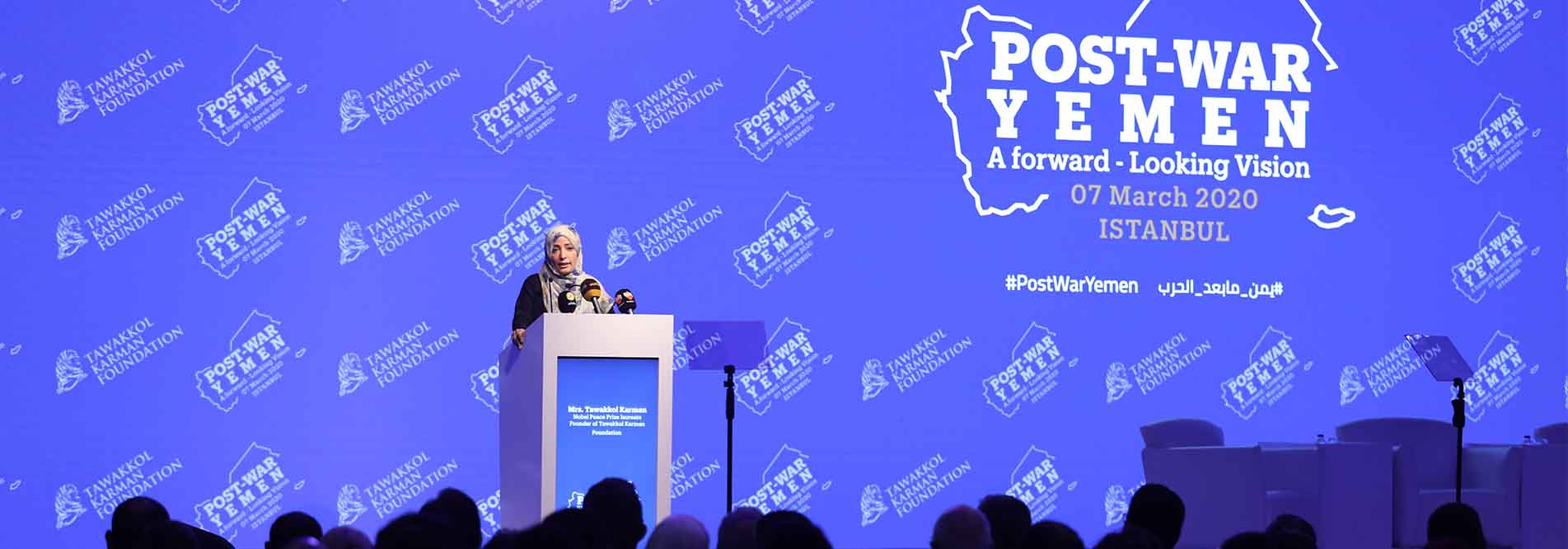
Yemeni, Arab and international experts gathered in Istanbul on March 7, 2020, for a conference organized by Tawakkol Karman Foundation to examine how Yemen might emerge from war and begin building a unified, sovereign and peaceful state.
The conference, titled “Postwar Yemen: A forward-looking vision,”
brought together intellectuals, researchers, political analysts and activists for three sessions addressing the end of the conflict, regional and international influence, transitional justice and reconstruction.
Speaking at the event, Nobel Peace Prize laureate Tawakkol Karman called on Yemeni military commanders, local authorities and resistance forces to establish a unified field command tasked with restoring state authority and ending militia control, foreign guardianship and occupation.
Karman said Yemen was facing a serious leadership vacuum and argued that decisions shaped by external powers did not reflect the country’s sovereignty or legitimate national will. She also criticized the weakness of the internationally recognized government and said its leadership lacked the independence needed to represent Yemen effectively.
She stressed that ending the fighting would be only the first step toward achieving genuine and lasting peace. Saudi Arabia, she said, should provide guarantees that it would end its guardianship over Yemen and contribute to rebuilding the destruction caused during the war.
Karman warned that partial agreements could prolong the conflict by addressing the interests of armed groups while ignoring Yemen’s central national questions.
“Yemen rejects both imamate rule and partition,” she said, adding that the country would not submit to the influence of Saudi Arabia or the United Arab Emirates.
She also said the war could not be resolved through deals among rival leaders who lacked a commitment to a unified, strong and sovereign Yemeni state. Karman accused the Houthi militia of initiating the conflict and failing to demonstrate a genuine willingness to pursue peace or accept political pluralism.
She called on the international community to increase pressure on the group to return to an inclusive political process.
Tuğba Işık Ercan, deputy chair of foreign relations for Türkiye’s Justice and Development Party, reaffirmed Türkiye’s support for a unified and sovereign Yemen. She also said Türkiye remained committed to helping ease the humanitarian crisis affecting millions of Yemenis.
The conference opened with a session on possible scenarios for ending the war and the future structure of the Yemeni state. Participants examined potential systems of government and the political arrangements that could follow a negotiated end to the conflict.
Speakers included Ahmed Al-Sayyad, Yemen’s former ambassador to UNESCO; Ibrahim Al-Qatabi, a political analyst and activist; J.E. Peterson, a researcher specializing in Middle Eastern affairs; and Marwan Al-Ghafori, a Yemeni novelist and cardiologist.
A second session explored the future of regional and international influence in postwar Yemen. Participants included political analyst Ali Al-Absi; William Law, editor of Arab Digest and a former BBC correspondent; journalist and conflict researcher Jonathan Harvey; and Stephen W. Day, professor of international affairs at Lawrence University.
The third session focused on postwar priorities, including transitional justice, ending the conflict and the political and legal responsibilities involved in reconstruction.
Speakers included Abbas Aroua, a physics professor and founder of Cordoba Foundation of Geneva; Franck Mermier, a senior researcher at the French National Centre for Scientific Research; Jamila Ubaid, a Yemeni economic journalist; and Mohammed Al-Misfer, a diplomat and professor of political science at Qatar University.
Discussions throughout the conference addressed the steps needed to stop the war, overcome the current political crisis, establish a modern Yemeni state and rebuild the country after five years of conflict.
See Post War Yemen..A forward-Looking Vision Conference Photos