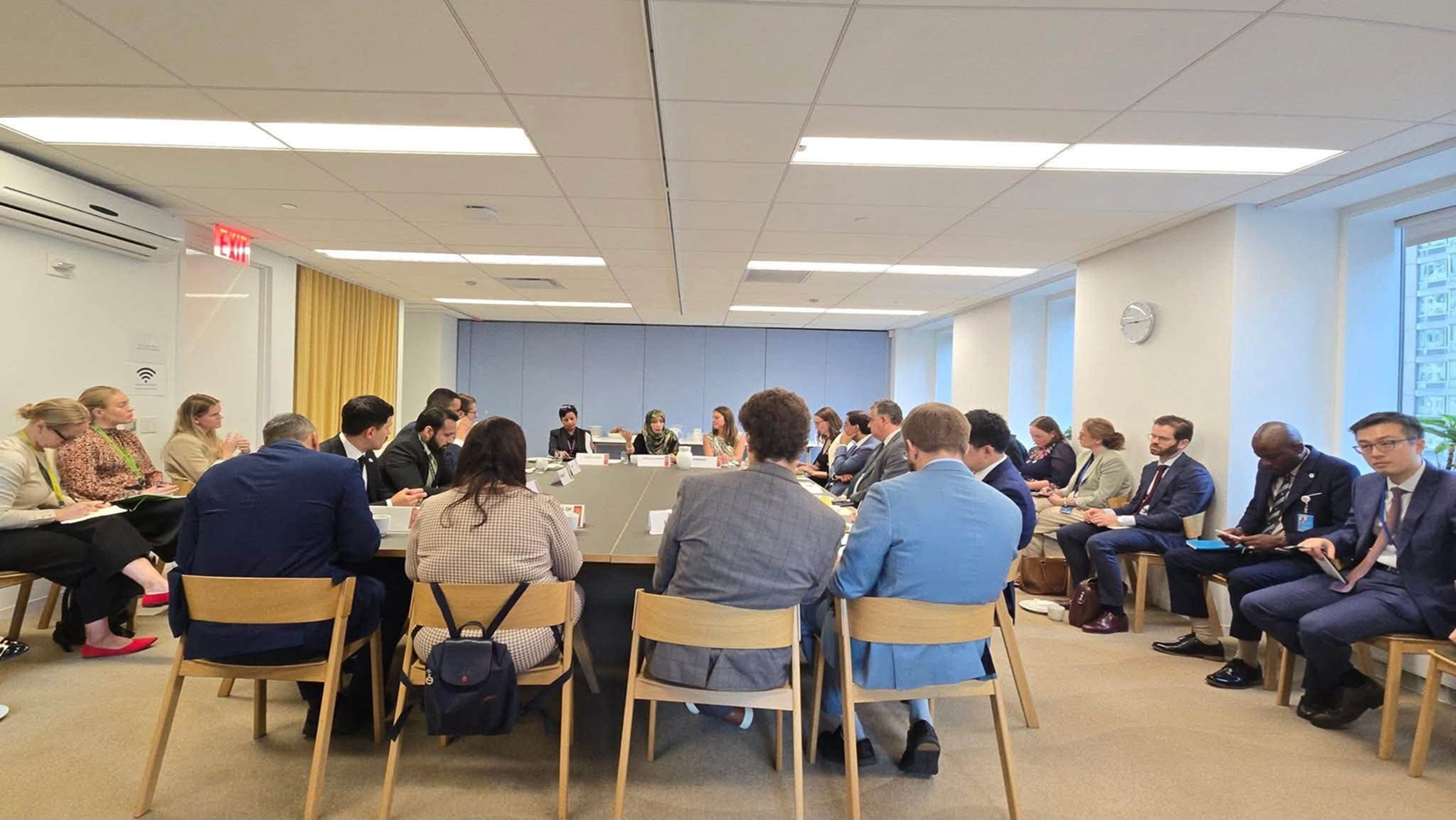
Human rights advocate and Nobel Peace Prize laureate Tawakkol Karman held an extended, ninety-minute exchange with members of the United Nations Security Council in a frank and wide-ranging discussion on the roots of Yemen’s collapse, its humanitarian and economic consequences, and the conditions she considers essential for lasting peace.
The meeting brought together representatives of all five permanent members of the Council — the United States, the United Kingdom, France, Russia and China — along with representatives of the Council’s elected members.
Karman argued that Yemen’s humanitarian catastrophe — marked by economic collapse, hunger, the breakdown of essential services, landmines and arbitrary detention — is not a series of isolated tragedies, but the consequence of a larger national calamity: the collapse of the Yemeni state and the dismantling of its institutions following the Houthi coup, backed financially, militarily and logistically by Iran.
She warned that treating the symptoms while leaving the underlying cause unaddressed would merely amount to managing the crisis and postponing a more severe eruption. Putting abuses, mistakes and foreign interventions in their proper context, she said, should not be understood as justification for tolerating them, but rather as a reason to move without delay toward addressing the root cause of the conflict.
Karman outlined the pillars of what she described as a sustainable settlement, grounded in Yemen’s national consensus framework and relevant United Nations resolutions, particularly the outcomes of the National Dialogue Conference and Security Council resolutions.
At the heart of her vision is a single, fully sovereign Yemeni state exercising exclusive authority over the entire national territory, with all military and security formations placed under its authority.
She called for an open and genuinely competitive political process in which all Yemeni political and social components, without exception — including the Houthis — would be able to participate through elections and lawful civic and political activity.
Political participation, she stressed, must remain a right guaranteed to all, provided that armed actors fully relinquish their weapons and abandon any militias or parallel structures operating outside the authority and legitimacy of the state.
“Restoring the state does not mean eradication or endless war,” Karman said. “It means placing everyone under the rule of law and democracy and abandoning the logic of armed force.”
She urged Security Council members — whose governments had previously sponsored Yemen’s peaceful political transition — to assume their historical responsibilities and move beyond crisis management. She called for active support for the restoration of the Yemeni state through a broad range of political, diplomatic, economic and legal instruments.
Karman underscored the need to support Yemen’s internationally recognized government and strengthen its institutions so they can deliver public services and carry out their economic responsibilities from within the country. At the same time, she cautioned against granting armed groups operating outside the state framework political legitimacy or treating them in ways that entrench them as parallel authorities, warning that such an approach would raise the cost of a settlement and undermine the prospects for a peaceful resolution.
She warned that the continued failure to address the roots of Yemen’s crisis has already transformed the Houthi coup from a domestic catastrophe into a direct threat to the wider region and, ultimately, a challenge to international peace and security.
She pointed to the growing impact on global supply chains, international trade and energy security in the Red Sea and around the Bab al-Mandab Strait.
Karman also noted that armed militias have increasingly become operational instruments within Iran’s broader regional influence project. Restoring the Yemeni state and securing its stability, she argued, is therefore no longer solely a Yemeni national interest, but an urgent strategic necessity for safeguarding the security of the region and the wider world.